I bought my first Harrington jacket because Steve McQueen was wearing one in a photo I liked, and I didn’t know anything about the jacket beyond that. I’ve since learned that’s basically how the whole jacket sells itself, on the strength of everyone who’s worn one before you.
That’s rare. Most jackets sell you on fabric or fit. This one sells you on the company.
This guide is built around what actually makes the Harrington worth owning: where it came from, what makes an original different from an imitation, and how to wear it without it looking like a costume.
Table of Contents
What is a Harrington Jacket?
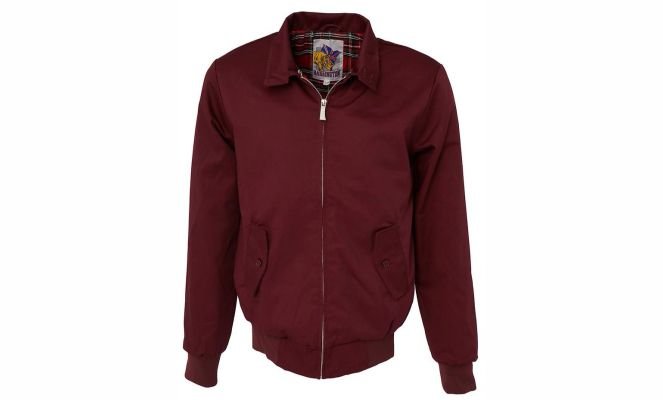
A Harrington jacket is a short, waist-length casual jacket with a trim, tailored silhouette and a distinct set of design details that haven’t changed much since the 1930s.
It sits closer to the body than a bomber or field jacket, closes with a zipper rather than buttons, and typically comes in cotton or a cotton-blend shell in navy, black, tan, or olive.
The defining features are a two-button stand collar, slanted front pockets, ribbed cuffs and waistband, and, on genuine versions, a tartan lining.
It’s built to be worn open or fully zipped, over a T-shirt, polo, or Oxford shirt, and it reads equally at home on a golf course, a college campus, or a city street, which is exactly what it was designed to do.
Where the Harrington Actually Came From
The Harrington didn’t start as a Harrington at all. Baracuta traces the jacket back to 1937, when brothers John and Isaac Miller in Manchester designed a lightweight, weatherproof golf jacket they called the G9, the “G” for golf and the “9” for a course’s nine holes.
A year later, InsideHook notes the Millers approached Lord Lovat, chief of Clan Fraser, for permission to line the jacket in the family’s tartan.
He said yes, and that tartan lining is still the single detail that separates a real Harrington from every look-alike sold since.
The name “Harrington” came decades later, and almost by accident. Gentleman’s Gazette explains that actor Ryan O’Neal wore the G9 constantly while playing Rodney Harrington on the soap opera Peyton Place in 1964, and the association stuck so completely that Baracuta eventually adopted the name itself.
By then, the jacket had already been worn by Steve McQueen, James Dean, and half the Ivy League, so it arrived with a reputation before it had an official name.
What I find genuinely interesting about that history is how unglamorous the jacket’s origin actually was.
It wasn’t designed to look like anything. It was designed to keep golfers dry between holes.
Everything since, the movie stars, the mod and punk subcultures that adopted it in the decades after, the preppy Ivy League association, got layered on top of a jacket built for a completely practical reason.
That’s part of why it still works with almost anything. It was never trying to make a statement in the first place.
What Actually Makes It a Harrington
A true Harrington has a short list of non-negotiable details, and once you know them, spotting a cheap imitation gets easy.
- The tartan lining is the biggest tell, since Baracuta still uses the Fraser tartan by name, a detail budget versions almost always fake with a generic plaid.
- A two-button stand collar sits at the neck rather than lying flat, and the front pockets sit at a slight slant, a detail Baracuta notes was originally sized to hold two golf balls.
- Ribbed cuffs and a ribbed waistband keep the jacket close to the body without a single button or drawstring doing that work.
- The whole thing is meant to be waist-length and unlined enough to move freely, since it was, after all, built for a golf swing.
None of these details is decorative for its own sake. Every one of them solved a real problem for someone standing on a wet Manchester golf course in 1937, which is probably why the design has needed almost no updating since.
Fit: Where Most Men Get This Jacket Wrong
The Harrington is supposed to be trim. That’s the whole silhouette, and it’s the detail I see go wrong most often, usually because a man tries one on expecting the roomier fit of a bomber or field jacket and buys a size up out of habit.
Shoulders should sit close to your actual shoulder line, with no room to spare.
The waistband should sit at your hip, not below it, and it should hug rather than hang.
Sleeves should end right at the wrist, since the ribbed cuff is meant to be visible, not hidden under excess fabric.
If you can’t tell where your body ends and the jacket begins, it’s too big.
This is a jacket built to look neat, almost tailored, even though it’s fundamentally casual. That tension is exactly what makes it work.
How I’d Actually Wear One
The Harrington’s real strength is that it sits right on the border between casual and put-together, which means it works in more situations than almost any other jacket in this series.
- The original formula: a plain T-shirt or polo, straight jeans, and simple sneakers or boots. This is close to how it’s been worn since the 1950s, and there’s a reason nobody’s improved on it.
- Smart casual: an Oxford shirt underneath, straight chinos instead of jeans, and clean leather shoes. This is the version I’d wear to an office that doesn’t require a blazer.
- Cooler weather: a lightweight sweater underneath instead of a shirt, since the Harrington isn’t built to be your warmest layer, just your top one.
- One thing I’d actively avoid: pairing it with anything else that’s trying to make a loud statement. The jacket already has a strong silhouette. Let it be the most interesting thing in the outfit, not one of several.
Buying One: What’s Worth the Money
A genuine Baracuta G9 costs considerably more than a Harrington-style jacket from a mainstream retailer, and that price gap is entirely about the details above, not marketing.
If you want the real tartan lining, the actual two-way zipper, and a jacket built the way the original was built, that’s where the extra cost goes.
That said, I don’t think every man needs the original to get the point of the jacket.
A well-made Harrington-style jacket from a mainstream brand, with a genuine ribbed cuff and a properly slanted pocket, will do the job for most wardrobes.
Where I’d draw the line is fabric quality and fit, not the label. A stiff, boxy imitation misses the entire appeal of the jacket, regardless of price.
Conclusion
The Harrington earns its reputation honestly, since almost every detail on it was solving a real problem before it ever became a style.
The tartan lining, the slanted pockets, the trim, the ribbed silhouette, all of it traces back to a jacket built for movement on a wet golf course in 1937.
Getting the fit right, close through the shoulders and waist, matters more with this jacket than almost any other on this site.
Read our full men’s jackets guide for where this style fits into a complete wardrobe.
Frequently Asked Questions
What makes a jacket a true Harrington?
A tartan lining, usually the Fraser tartan on genuine Baracuta pieces, along with a two-button stand collar and slanted front pockets. Ribbed cuffs and waistband complete the silhouette, keeping the jacket trim without any buttons or drawstrings.
Why is it called a Harrington jacket?
Actor Ryan O’Neal wore the Baracuta G9 constantly while playing Rodney Harrington on the show Peyton Place in 1964. The association stuck so firmly that Baracuta eventually adopted the name for the jacket itself.
Should a Harrington jacket fit loose or fitted?
Fitted, close through the shoulders and waist, with sleeves ending right at the wrist. A Harrington bought a size too big loses the trim silhouette that defines the jacket.
Is the Harrington jacket still in style?
Yes, it has stayed in steady rotation across Ivy League, mod, punk, and preppy styles since the 1950s. Its plain, practical silhouette has never really depended on any single trend cycle to stay relevant.

Pyo Merez is a 45-yeard old husband, father, and a chemical engineer by profession and the founder of Gentsways, a men’s lifestyle site built in honour of his father, Dee Clement. He has been writing about men’s development, style, and character through his father’s lens since 2021, drawing on lived experience, his father’s example, and research from reputable publications. He is not a certified trainer or therapist; where fitness or health topics require it, articles are reviewed by qualified contributors.