

Most advice on personal development for men repeats the same seven words: mindset, confidence, discipline, purpose, without ever explaining what actually changes behavior, which is why most men read it, nod, and go back to exactly what they were doing before.
I spent years in one career, chemical engineering, before looking towards a completely different one, graphic design, and the hardest part was never learning new skills.
It was unlearning the belief that I had to stay who I already was.
Change is one hell of a tough nut for some people, while it is a breeze for others.
Personal development thrives on change, which is brought about by learning, unlearning, and relearning.
In men’s lifestyle and culture, style, grooming, and health cover a man’s body, while personal development covers his mind and spirit: the discipline, judgment, and sense of purpose that decide what he actually does with that body once he’s dressed, groomed, and well.
This guide discusses: discipline, goal-setting, resilience, self-awareness, money, philosophy, and purpose- the mind and spirit half of what this site is built on.
Table of Contents
What Personal Development Actually Means for Men
Personal development is the deliberate work of improving how you think, act, and relate to other people, across mindset, money, resilience, and purpose.

It is not a single fixed program. It is closer to maintenance you never stop doing, because the version of yourself that worked at 25 rarely still works at 40 without adjustment.
Two foundational pieces live elsewhere on the site and deserve full guides rather than a summary here.
Our full guide to the mindset of a high-value man covers how you respond to setbacks and feedback, and how confidence builds a real man covers social skills and self-assurance.
What follows here is everything else.
Discipline and Habit Formation
The “21 days to build a habit” claim gets repeated constantly, and it isn’t true. It traces back to a 1960 plastic surgery book, not behavioral research.

The actual number, based on tracking 96 people forming real daily habits, is a median of 66 days, with a wide range from 18 to 254 days depending on the habit and the person, according to research from University College London.
Missing a single day did not derail the process. Persistent inconsistency did.
That has two practical implications. First, expect two to three months before a new habit feels automatic rather than forced, not three weeks.
Second, one missed day is not failure; it’s noise.
The habit that survives inconsistency is the one built on realistic expectations instead of willpower alone.
Goal Setting and Productivity
A version of the “Yale study of goals,” where a graduating class supposedly wrote down goals and earned ten times more twenty years later, gets cited constantly in business and self-help circles.
It never happened. It’s an urban myth, confirmed as fabricated by researchers who went looking for the original study and found nothing.
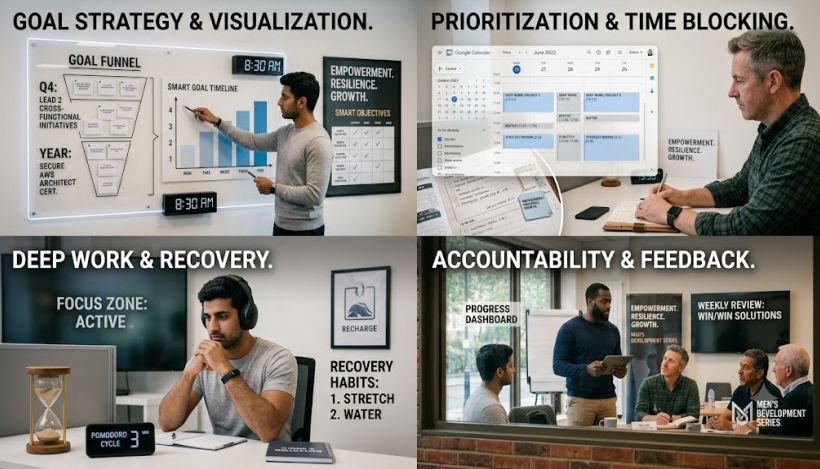
What does hold up is Dr. Gail Matthews’ actual study at Dominican University of California, which tracked 267 real participants.
Those who wrote down their goals, committed to specific actions, and sent weekly progress updates to another person were dramatically more successful than those who kept goals in their head, with success rates around 70 percent for the accountability group versus 35 percent for those who never wrote anything down.
The lesson isn’t “write goals down and wait.” It’s writing them down, committing to a specific action, and building in outside accountability, all three together.
Career Development
Career growth responds to the same discipline covered above, applied consistently rather than in bursts before a review.

Purpose matters here more than most men expect: employees with a strong sense of purpose in their work are engaged at more than five times the rate of those without it, according to Gallup’s research on purpose and engagement.
See our full guide to career growth for men for the practical playbook, and our guide to future-proof careers if you’re weighing a change in direction entirely.
If remote or flexible work fits your situation better, see our guides on setting up a home office, productivity tools for admin work, and high-paying remote side hustles.
Resilience and Overcoming Setbacks
Setbacks- job loss, a failed venture, a relationship ending hit men particularly hard because so many of us are conditioned to treat struggle as something to hide rather than process.

Resilience isn’t the absence of difficulty. It’s the capacity to keep functioning and adapting while going through it.
Practically, that means separating the event from the story you tell yourself about it. Losing a job is a fact.
“I’m a failure” is an interpretation, and usually an inaccurate one.
Talking to someone- a friend, a mentor, a therapist- about a real setback processes it faster than carrying it alone, and it’s a habit worth building before you need it, not after.
Self-Awareness and Reflection
Self-awareness is knowing your actual strengths and weaknesses, not the flattering or self-critical version, and it lets you direct effort where it matters instead of where your ego wants attention.
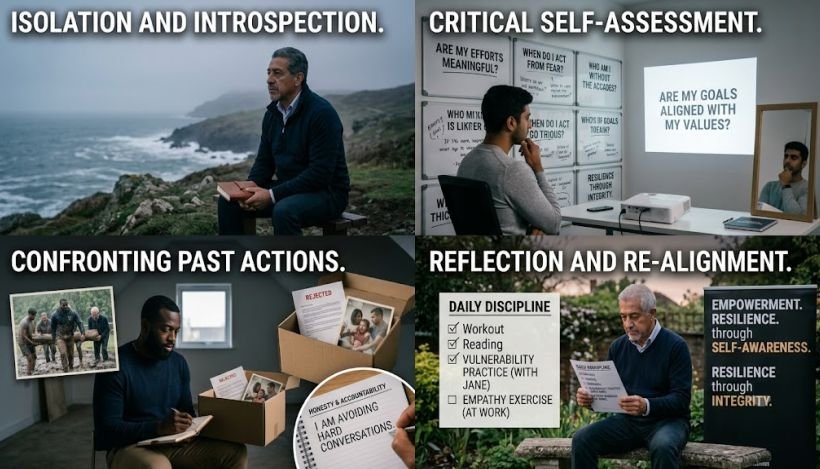
Journaling is one of the most direct tools for building it.
Regular expressive writing measurably reduces stress and improves mood, according to research reviewed by the Child Mind Institute.
It works by helping organize scattered thoughts into something you can actually examine.
A simple version: five minutes at the end of the day, what happened, how you responded, and what you’d do differently.
No app or system required, just consistency, the same principle covered in the habit-formation research above.
Financial Growth and Wealth Building
Financial literacy in the US is lower than most people assume.
Only 27 percent of Americans correctly answered at least five of seven basic financial literacy questions in a recent national survey, according to FINRA’s National Financial Capability Study.

That gap is exactly why budgeting and basic investment knowledge function as a real advantage rather than a given.
Start with the fundamentals: building credit from scratch and choosing the right credit cards if you’re early in that process.
From there, investing in your 30s and real estate investing for beginners cover the next stage, and our review of whether Financial Peace University is worth it and our guide to achieving financial freedom early round out the path from first steps to long-term independence.
A Practical Philosophy for Men
Stoicism gets name-dropped constantly in men’s self-improvement content, usually reduced to “don’t feel things.” That’s a shallow reading.

The actual practice- focus only on what you control, treat obstacles as material to work with rather than injustices to resent has held up for two thousand years for a reason: it’s a discipline, not a personality trait.
A short daily practice, five minutes reviewing what went well, what didn’t, and what was actually within your control, does more for long-term resilience than most productivity systems marketed at men today.
It’s free, it takes less time than scrolling, and it compounds the same way the habit research above describes.
Spirituality and Meaning
Spirituality doesn’t require a specific religion, though for many men it includes one.

At its core, it’s the practice of connecting to something larger than immediate wants, whether that’s a faith tradition, meditation, time in nature, or simply regular reflection on what actually matters to you.
A consistent meditation or quiet-reflection practice, even five to ten minutes daily, builds the same kind of mental discipline covered throughout this guide: the ability to notice a reaction before acting on it.
Men who dismiss this territory as “not for them” are often the ones who’d benefit from it most, since it’s frequently coded as soft rather than as the discipline it actually is.
Purpose and Legacy
Purpose isn’t a mystical discovery; it’s usually the byproduct of consistent contribution to something outside yourself.

Mentorship is one of the most direct paths to it: teaching someone else what you’ve learned forces you actually to understand it, not just perform it.
My own father never framed anything he did as a “legacy project.”
He read constantly, stayed calm under pressure, and let all of that show up in ordinary moments instead of grand speeches.
Legacy, in practice, looks more like that than like anything dramatic.
How to Start Your Personal Development Journey
Pick one area from this guide, not all of them at once.
Set one specific, time-bound goal within it, write it down, and tell one other person so you have real accountability, following the model that actually worked in the research above.
Track it daily for at least 66 days before judging whether it’s working.
For deeper reading, Stephen Covey’s The 7 Habits of Highly Effective People and Daniel Goleman’s Emotional Intelligence both hold up well.
The Art of Manliness podcast and The Tim Ferriss Show offer ongoing, practical perspectives worth adding to a regular rotation.
Conclusion
Real personal development doesn’t come from reading more advice; it comes from picking one area, applying real discipline to it for longer than feels comfortable, and adjusting based on what the evidence actually shows works.
The habit research above says two to three months, not three weeks.
The goals research says write it down and tell someone.
Start with whichever section above matches where you actually are right now, not where you think you should be, and give it the time the research says it needs.
Frequently Asked Questions
What is personal development for men?
Personal development for men is the deliberate work of improving mindset, discipline, resilience, self-awareness, finances, and purpose across every stage of adult life.
How long does it actually take to build a new habit?
Research from University College London found a median of 66 days, not the commonly cited 21, with a range from 18 to 254 days depending on the habit.
Does writing down goals actually help achieve them?
Yes, but the famous “Yale study” claiming this is a myth. Real research from Dominican University found writing goals down plus outside accountability roughly doubled success rates.
How does journaling improve self-awareness?
Regular expressive writing reduces stress and improves mood by helping organize scattered thoughts into something you can examine, according to research reviewed by the Child Mind Institute.
Where should I start my personal development journey?
Pick one area, write down one specific goal, tell someone else for accountability, and track it daily for at least two months before judging results.