
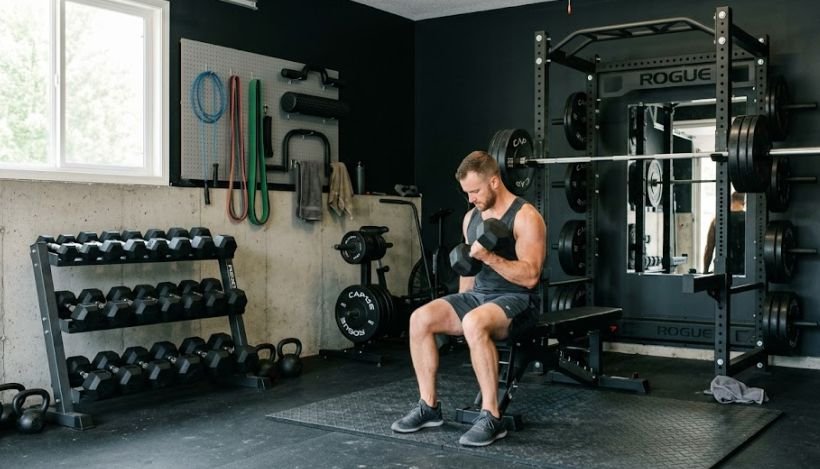
Most home gyms turn into laundry rooms with dumbbells stacked in a corner within six months, not because men lack motivation, but because the space itself was never actually planned to support a real training routine in the first place.
A home gym earns its keep when the space gets planned before a single piece of equipment gets purchased, yet most men reverse that order entirely.
They buy a rack, a bench, and a set of dumbbells, then discover the garage door won’t clear the barbell or the floor can’t handle dropped weight.
Research backs this up: home exercisers show meaningfully higher long-term adherence than gym members, according to a 2023 study published in Frontiers in Psychology.
This guide covers choosing the right space, planning layout and flooring, and picking equipment by goal and budget, so the room gets used.
Disclaimer: This article is for informational purposes only and does not constitute medical, fitness, or professional advice. The author is not a certified personal trainer, licensed therapist, nutritionist, or medical doctor. Where content is based on personal experience or observation, this is stated clearly in the article. Always consult a qualified professional before making significant changes to your health, fitness, or wellness routine.
Table of Contents
What a Home Gym Setup Actually Is (and Why Every Man Should Have One)
A home gym setup means a dedicated space in your house built around fitness equipment you own and control, separate from any membership you have to drive to.
It can be as small as a folded mat and a set of resistance bands tucked into a bedroom corner, or as built out as a converted garage with a full rack and a rowing machine.
What separates a real setup from a pile of equipment is intention: the space gets planned first, and each piece gets chosen for a specific reason.
Every man benefits from one for a few plain reasons. Training becomes something you can do in the ten minutes before work starts, not something that requires a drive, a parking spot, and a locker room first.
Consistency improves because the biggest barrier to training, actually getting there, disappears completely once the equipment sits down the hall.
The space also becomes personally yours in the same way a well-built home office or reading corner does, a room that reflects what you actually care about rather than whatever came with the lease.
How I Built a Home Gym Growing Up
Growing up, my four brothers and I built our first weights out of cement, sand, and old paint tins, poured into molds and left to set overnight in our backyard.

We had no real dumbbells or barbell, but we wanted to build muscle and feel fit, so we worked with what we had.
Each of us made a quiet promise that once we had our own homes, we’d carve out proper space for real equipment instead of improvising.
That promise has held: I now keep a small setup of my own fitness equipment at home, built the right way this time.
A rented apartment can limit how much space or equipment you’re able to install, but a real commitment to fitness usually finds a way around that limit, even if it starts small.
Why Space Planning Comes Before Equipment
Most home gym failures start with an equipment order form rather than a tape measure, and that single mistake creates almost every problem that follows.
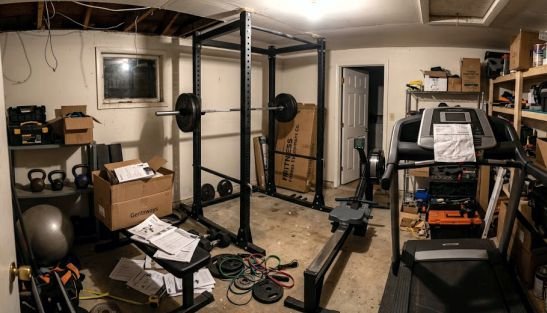
A squat rack that doesn’t clear the ceiling, a rowing machine that blocks the door, and a treadmill nobody can walk around are layout failures, not equipment failures.
Getting the room right before buying anything protects both your money and your motivation, since a room that works keeps getting used long after the initial excitement fades.
This is the same buy-less-buy-better principle already covered in Gentsways’ guide to men’s home and living, applied here to a training space instead of a living room.
Choosing the Right Space in Your Home
Not every home has a spare room, and that’s fine; a home gym describes a function, not a specific room type.
- Garage: Offers the most square footage and the least concern about noise or dropped weight, but needs insulation or a space heater in cold climates.
- Basement: Keeps equipment out of daily sightlines and usually has a concrete floor already suited to heavy training.
- Spare bedroom: Works well for a quieter setup focused on cardio or mobility work, though the ceiling height can limit overhead barbell work.
- Corner of a living room or apartment: A realistic option for renters; a foldable rack and rubber tiles can turn 10 square feet into a workstation.
- Shed or outdoor structure: Suited to warmer climates and men who want full separation between training and the rest of the house.
Pick the space based on the training you actually plan to do, not the room that happens to be empty right now.
How Much Space You Actually Need
A minimalist setup built around adjustable dumbbells, a bench, and a pull-up bar can work in as little as 36 to 64 square feet.
A full setup with a squat rack, barbell, plates, and a cardio machine generally needs closer to 150 to 250 square feet to move around safely.
A typical one-car garage measuring 12 by 20 feet requires roughly 240 to 265 square feet of rubber matting to cover the training area properly, according to a flooring guide from RitFit.
Measure your actual space, including door swing and ceiling height, before deciding what equipment can realistically fit.
Flooring: The Most Overlooked Investment
Flooring gets skipped more than any other decision, and it’s the one that protects both your joints and your house.
Interlocking rubber tiles between three-eighths and three-quarter inch thick handle most home training needs, with the thicker end reserved for dropped barbells or Olympic lifts.
Horse stall mats, sold at farm supply stores for roughly $45 to $50 per 4×6-foot mat, offer the same three-quarter-inch solid rubber used in commercial gyms at a fraction of the branded price, according to HomeFitnessLab’s flooring guide.
Rubber flooring also cuts down on noise transfer, which matters if you’re training above a shared floor or below a bedroom.
A few flooring basics worth following:
- Measure your space and add 5 to 10 percent extra material for cuts around walls and equipment bases.
- Use double-sided tape on seams instead of full glue-down installation, since it’s easier to adjust later.
- Choose thicker mats specifically under a squat rack, bench, or deadlift zone rather than the whole room.
Layout, Lighting, and Ventilation
A gym that feels cramped or dim gets avoided, regardless of how good the equipment is.
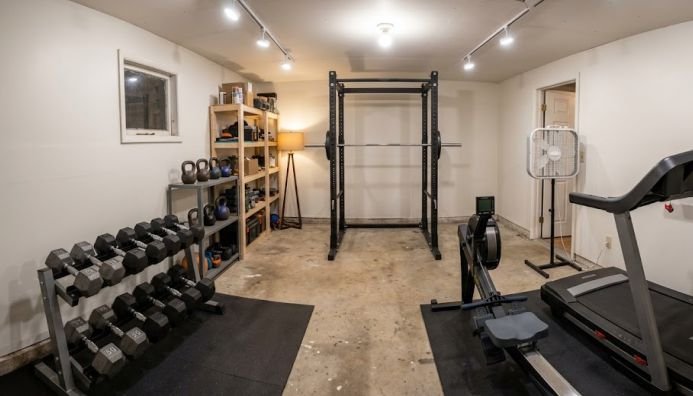
Leave at least two feet of clearance on every side of a rack or bench so movements don’t feel restricted.
Bright, layered lighting- an overhead fixture plus one accent light, makes the room feel less like a storage closet and more like a place worth showing up to.
Airflow matters just as much: a box fan or small ventilation unit keeps a garage or basement gym usable through summer training sessions.
Core Equipment by Training Goal
Buy equipment based on what you’re actually training for, not what looks complete on a showroom floor.
Strength training
- Power rack or squat stand
- Olympic barbell and a full set of plates
- Adjustable bench
- A set of adjustable dumbbells
Cardio
- Rowing machine or an air bike
- Jump rope
- A compact set of resistance bands for warm-ups
Mobility and recovery
- Exercise mat
- Foam roller
- Resistance bands, which also support recovery and joint-friendly training covered in more depth in Gentsways’ guide to fitness for older men
Small-space or apartment setup
- Adjustable dumbbells that replace an entire rack of fixed weights
- A doorframe pull-up bar
- A folding bench that stores against a wall
Building the Space in Phases
Buying everything at once is the fastest way to overspend or fill a room with equipment you never actually use.
Start with the two or three pieces tied to your main training goal, then add equipment as your routine proves it out.
This mirrors the same phased approach already covered in Gentsways’ bachelor pad guide: buy what you’ll use daily first, then build outward.
Roughly 29 percent of American exercisers bought fitness equipment for home use in the years following the pandemic, according to industry data compiled by PT Pioneer, and most of that spending happened gradually rather than in one large purchase.
Building a repeatable habit around a space matters more than filling it quickly, a principle covered further in Gentsways’ guide to personal development.
Noise, Renters, and Shared Walls
If you’re renting or sharing a building, noise and floor protection deserve real thought before you buy anything that involves dropped weight.
Rubber flooring absorbs a large share of impact noise, and choosing dumbbells with rubber coating over exposed iron plates cuts down on both noise and floor damage.
Renters should also confirm what a landlord allows before installing wall-mounted equipment like a pull-up bar or a squat stand anchored to a wall stud.
A Space That Supports the Rest of Your Routine
A home gym works best when it connects to the rest of your health routine instead of sitting apart from it.
Resistance training done in a well-built space also ties into the hormonal side of men’s health covered in Gentsways’ guide to testosterone.
Training consistency ties directly into recovery too, covered in Gentsways’ guide to sleep and testosterone, since poor sleep undercuts even a well-built training space.
The training itself connects to the broader guidance in Gentsways’ men’s fitness guide, which covers programming, nutrition, and mindset in more depth than a home setup guide reasonably can.
Adjusting the Setup for Older Men
A home gym built for a man in his 20s and one built for a man in his 60s can share the same room but shouldn’t share the same equipment list.
Resistance bands, wall-mounted trainers, and non-slip flooring matter more here than heavy free weights, and Gentsways’ dedicated guide to fitness for older men covers specific gear picks suited to joint health and balance.
The space-planning and flooring guidance above still applies regardless of age or training goal.
Conclusion
A home gym isn’t defined by how much equipment fills the room; it’s defined by real, ongoing use six months from now.
Measure the room, invest in flooring before anything else, and buy equipment in phases tied to your real training goal rather than what looks impressive on day one.
Start with the space you already have, a garage, a spare room, or one corner of an apartment, and build outward from there.
For the training itself, see Gentsways’ complete guide to men’s fitness for programming and nutrition that make the space worth building.
Frequently Asked Questions
How much space do I actually need for a home gym?
A minimalist setup fits in 36 to 64 square feet, while a full rack, bench, and cardio machine typically needs 150 to 250 square feet of dedicated floor space.
What flooring works best for a home gym?
Interlocking rubber tiles between three-eighths and three-quarter inch thick protect concrete or hardwood floors, absorb impact from dropped weights, and cut down noise for shared walls.
What equipment should I buy first for a home gym?
Start with an adjustable bench, a barbell with plates, and a pull-up bar, since these cover most strength goals without requiring a full rack right away.
Can older men use a home gym safely?
Yes, with adjustments like resistance bands, wall-mounted trainers, and non-slip flooring; see Gentsways’ dedicated guide to fitness for older men for specific gear picks.

Pyo Merez is a 45-yeard old husband, father, and a chemical engineer by profession and the founder of Gentsways, a men’s lifestyle site built in honour of his father, Dee Clement. He has been writing about men’s development, style, and character through his father’s lens since 2021, drawing on lived experience, his father’s example, and research from reputable publications. He is not a certified trainer or therapist; where fitness or health topics require it, articles are reviewed by qualified contributors.