
Last updated on September 21st, 2026 at 03:59 pm
Most men treat their home as an afterthought, something they’ll fix “eventually,” when the space you actually live in shapes your energy, focus, and confidence every single day.
Your home isn’t just where you sleep, it’s the backdrop to everything else on this site, how you dress, how you host people, how you actually recharge after a long week.
Growing up, my father, Dee Clement, kept one room in our family home entirely his own that was different from his bedroom, a space he called his Comfort Zone. It held his personal library, a set of diaries: small booklets per year where he recorded his days, and a large chair comfortable enough to sleep in if the evening called for it.
It contained other items, such as a table and awards racks.
He rarely let us in, and as kids, we half-joked he was part of some secret society in there. That room still exists in our family home today.
This guide is built on the same idea his room quietly taught me: a home doesn’t need to be large or expensive to mean something; it just needs to be built with intention.
This covers choosing the right living situation, furnishing it without waste, organizing it without obsession, and maintaining it without it becoming a second job.
Table of Contents
What Men’s Home and Living Actually Means
A well-built home isn’t primarily about decorating; it’s about a space that supports how you actually live.
Comfort and function matter more than any single aesthetic trend.
Quality over quantity applies here the same way it does to a wardrobe: fewer, better pieces beat a home full of things you don’t actually use.
My father raised six of us on a pharmacist’s income, and our house was never full of much, but everything in it had a purpose and a place.
That distinction, deliberate versus accidental, is the actual foundation of this whole guide.
Choosing the Right Living Situation
Whether it’s an apartment, house, studio, shared living, or condo, the right choice depends on your budget, work location, family needs, and how much maintenance you’re actually willing to take on.
Renting offers flexibility while your plans are still in motion.
Buying makes sense once your plans have real stability behind them, and once you’ve factored in the maintenance costs a landlord used to absorb for you.
This decision connects directly to the financial planning covered in our personal development guide, since housing is usually the largest recurring expense a man manages.
The Essential Rooms Worth Getting Right, and What Each One Actually Needs
Bedroom
A real bed frame and a mattress suited to how you actually sleep matter more than anything else in this room.
Bedroom clutter is linked to poorer sleep quality and more frequent sleep disturbances, according to a study presented at the SLEEP conference and published through Oxford Academic.
Though it’s worth noting the study population skewed heavily female, so the exact effect size for men specifically isn’t as well established.
The general direction still holds: a calmer bedroom supports better rest, which ties directly into our full guide to sleep and recovery.
Living Room
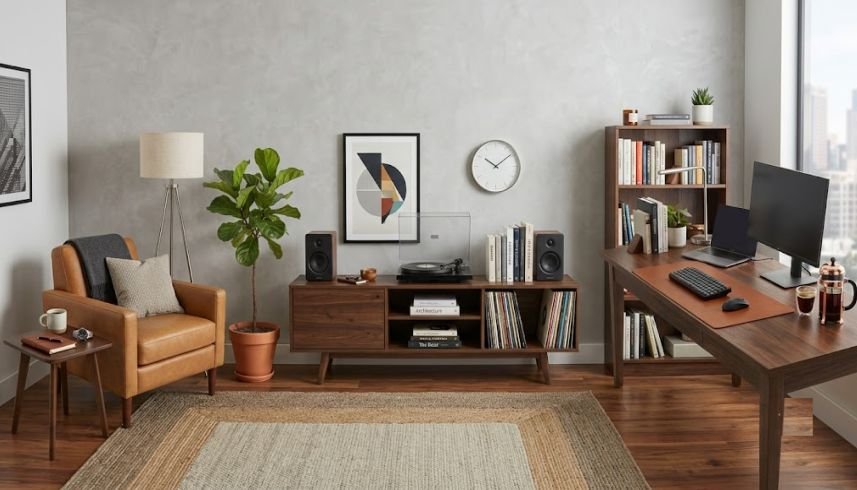
Built for entertaining and daily comfort in equal measure. One genuinely comfortable seating piece beats three mediocre ones.
Kitchen
A simple, functional setup beats an impressively equipped kitchen you never actually cook in.
Bathroom
Your grooming station lives here, and it’s worth setting up properly. See our complete grooming guide for what actually belongs on that counter.
Home office
If you work from home even occasionally, this deserves real thought. See our full guide to setting up a home office for the specifics.
Dining
Dining area, laundry, and outdoor space round out a fully functional home, even in a smaller footprint.
Interior Design Styles, and What Actually Distinguishes Them
- Modern favors clean lines and a restrained color palette, function expressed through simplicity.
- Industrial leans into exposed materials, brick, metal, raw wood, and works especially well in loft-style spaces.
- Scandinavian prioritizes light wood, soft neutral tones, and functional simplicity over visual statement.
- Mid-century modern brings in tapered wood furniture legs and warm tones, a style that’s aged well because it was never chasing trend to begin with.
- Rustic uses natural materials and a warmer, lived-in feel, better suited to a house than a modern apartment.
- Japandi blends Japanese minimalism with Scandinavian warmth, low furniture and negative space used deliberately.
- Classic gentleman’s style leans into leather, dark wood, and a more traditional, collected-over-time feel, closer to a study than a showroom.
None of these is objectively correct. A minimalist approach in particular pairs naturally with the capsule wardrobe philosophy already covered on this site, fewer, better pieces, chosen deliberately.
Color and Furniture Fundamentals
Neutral tones, earth tones, and darker palettes tend to anchor a space well, with one or two accent colors used deliberately rather than scattered throughout every room.
For furniture, prioritize spending on what you use daily, a bed and a couch, over what you use rarely.
A well-made piece bought once genuinely beats a cheap replacement bought three times.
Decor Without Clutter
Wall art, lighting, plants, and a few well-chosen objects add character without creating visual noise.
Some research links a cluttered environment to elevated stress markers, most notably a widely cited UCLA study on households and cortisol, though that study’s clearest effects showed up specifically in the women in the sample, with men’s stress response to clutter registering as comparatively stable.
Worth keeping honest rather than repeating the more dramatic version of this claim that gets recycled constantly online.
Organization and Home Maintenance
A simple, repeatable system beats an elaborate one you’ll abandon within a month: one dedicated spot for keys and mail by the door, a closet organized by category, a five-minute nightly reset of the kitchen and living room.
Building a repeatable system like this connects to the same principle covered in our guide to habit formation: consistency matters more than intensity, whether the habit is a workout routine or a closet system.
Basic home maintenance, a seasonal checklist, and a few emergency supplies on hand prevent small problems from becoming expensive ones.
Smart Home Technology
Smart lighting, locks, cameras, speakers, and thermostats can genuinely simplify daily life, though not every device is worth the cost or complexity.
Start with whichever solves an actual daily friction point rather than adopting every available gadget at once.
Man Cave and Entertainment Space
A man cave is a dedicated space built for entertainment and downtime, distinct from the solitary space covered above, this one’s meant for gathering, not retreating.
A well-set-up television and sound system, a dedicated corner for gaming, and the basics of a home bar all belong here.
The scale can range from a full basement build-out to a single well-arranged corner of a living room, the term describes the function, not the square footage.
Hosting well ties directly into the hospitality and etiquette already covered on this site, the space is just the setting for it.
Budgeting for Your Home
Prioritize purchases that get daily use, buy used where quality holds up over time, and avoid furnishing an entire home at once instead of building it deliberately, room by room.
Seasonal Home Care
Spring calls for deep cleaning and checking on winter damage.
Summer means maintaining outdoor space and checking cooling systems. Fall is the time for weatherproofing before cold arrives.
Winter focuses on heating efficiency and basic emergency preparedness.
Building a Home That Reflects You
The through-line across everything above is the same principle this whole site is built on: buy less, buy better, and build habits that keep the results looking good rather than relying on one big effort.
My father never had much, but the little he had was chosen, not accumulated, and that’s still the standard worth building toward.
Frequently Asked Questions
What makes a home feel intentionally designed rather than thrown together?
Consistency in color palette, furniture that’s built to last, and avoiding clutter matter more than any single decorating choice or trend.
How do you furnish a home without overspending?
Prioritize daily-use items like a bed and couch first, buy used where quality holds up, and furnish room by room rather than all at once.
Does bedroom clutter actually affect sleep quality?
Research suggests a link between bedroom clutter and reduced sleep quality, though most studies on this specifically examined predominantly female populations.
How do you keep a home organized without it becoming a chore?
Build simple, repeatable systems for your closet, kitchen, and entryway once, rather than relying on periodic deep cleans to fix ongoing disorganization.
Conclusion
A well-built home supports everything else in your life, work, rest, hosting, recovery- rather than existing separately from it.
Start with the room you use most, furnish it with pieces that actually last, and build simple habits that keep it working rather than requiring constant effort.
The rest of this guide’s sections will grow into their own dedicated posts over time, so bookmark this page as the place to come back to as that happens.

Pyo Merez is a 45-yeard old husband, father, and a chemical engineer by profession and the founder of Gentsways, a men’s lifestyle site built in honour of his father, Dee Clement. He has been writing about men’s development, style, and character through his father’s lens since 2021, drawing on lived experience, his father’s example, and research from reputable publications. He is not a certified trainer or therapist; where fitness or health topics require it, articles are reviewed by qualified contributors.