

Last updated on September 21st, 2026 at 04:00 pm
She thought she was alone, grabbing coffee, taking a detour, venting to a friend. But when she got home, he already knew. Not because she told him. Because he never needed her to.
Your phone knows where you are. So does your car, your smartwatch, and every app you’ve opened today.
But what happens when the person harvesting that information isn’t a corporation; it’s your husband?
Spousal tracking is rising quietly, tucked inside everyday technology most couples already use.
Some of it is consensual. Much of it is not. From hidden GPS devices to invisible spyware running silently on smartphones, men are monitoring their wives in ways that are increasingly easy to execute, and dangerously hard to detect.
This is how men are tracking their wives, what it looks like, why it happens, and what every woman needs to know.
Table of Contents
What Does It Mean to Track a Spouse?
Spousal tracking refers to any method, digital, physical, or technological, used by one partner to monitor the location, communications, or activities of the other.
It exists on a wide spectrum.
On one end sits a couple who mutually share their iPhone locations for convenience.
On the other end sits a husband who installs hidden software on his wife’s phone without her knowledge or consent.
Understanding that spectrum is essential because the technology itself is neutral.
What makes tracking healthy or harmful isn’t the tool; it’s the transparency, the consent, and the power dynamic behind it.
Understanding Modern Tracking Methods
The tools available for spousal surveillance have grown dramatically over the last decade.
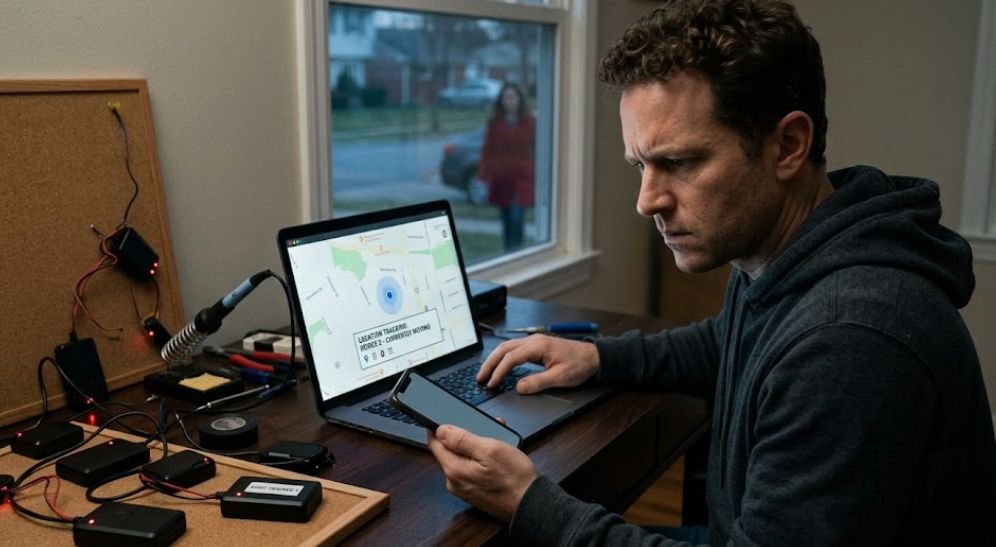
Most require no technical skill and cost very little.
Location sharing apps like Google Maps, Apple’s Find My, and Life360 allow real-time location visibility between users.
When both partners opt in willingly, these can serve a genuine purpose. When one partner is pressured or unaware, the same app becomes a surveillance instrument.
Smartphone Tracking Features
Smartphone tracking features are built directly into iOS and Android.
Features like “Share My Location” and background location access in apps can be toggled on without the phone owner noticing, especially if the person doing so has physical access to the device.
Vehicle Tracking Devices
Vehicle tracking devices are small GPS units that can be magnetically attached beneath a car or plugged into the OBD-II diagnostic port found in most vehicles made after 1996.
They transmit real-time location data to an app on a second phone. Many are marketed for fleet management but widely purchased for personal surveillance.
Social Media Activity Monitoring
Social media activity monitoring doesn’t require any special technology at all.
Checking location tags in photos, monitoring who a partner follows or messages, and noting when someone was “last active” are low-tech forms of tracking that many people don’t even recognize as surveillance.
Smart Home Technology and Connected Devices
Smart home technology and connected devices, including doorbell cameras, smart speakers, and connected security systems, can be used to monitor arrivals, departures, and even conversations.
In many homes, these devices were installed ostensibly for home security but serve a second function as spousal monitoring tools.
Why Some Men Track Their Wives
The motivations behind spousal tracking are varied, and not all of them are malicious.
Understanding the range helps distinguish protective instincts from controlling behavior.
Safety and Security Concerns
Some tracking is genuinely safety-oriented. A husband whose wife travels frequently for work may want to know when she lands safely.
Parents in some families use shared tracking to monitor one another during emergencies or to keep tabs on family members in high-crime areas.
In these cases, the tracking is typically known, agreed upon, and mutual.
Emergencies, accidents, medical events, and sudden breakdowns are legitimate scenarios where location sharing provides real value.
The difference is that in healthy relationships, both people know the arrangement exists and either party can opt out.
Relationship Concerns
Trust issues and suspicions of infidelity are among the most commonly cited reasons men give for covertly tracking their partners.
- Past experiences: A previous partner who cheated, a painful divorce.
- Childhood instability: Can create deep-seated anxiety that manifests as a compulsion to monitor.
What’s important to recognize is that these feelings, however real, do not justify covert surveillance.
Using hidden technology to manage personal insecurity is a boundary violation regardless of the emotional history behind it.
Convenience and Family Coordination
At the most benign end of the spectrum, location sharing simply makes family logistics easier.
Knowing when a spouse is on the way home helps with timing dinner.
Sharing location while navigating a busy venue makes meeting up simpler.
Coordinating school pickups, tracking a teenager’s whereabouts, or finding each other at an airport are all practical use cases that most couples navigate without friction.
The issue arises when convenience-framed tracking is one-sided, non-consensual, or used to question and interrogate a partner’s movements.
Popular Ways Men Are Tracking Their Wives Today
Smartphone Location Sharing
Built-in phone features are the most common tracking method because they’re already installed, easy to use, and difficult to detect if set up without the owner’s knowledge.
On an iPhone, “Share My Location” can be enabled in under 30 seconds.
On Android, Google account location sharing works similarly.
Family location-sharing apps like Life360, Find My Friends, and Google Family
Sharing are marketed toward parents monitoring children, but they’re frequently used between spouses.
These apps offer real-time location updates, movement history, and arrival/departure alerts.
When both partners agree to use them, the apps work as intended.
When one partner activates them on the other’s phone without disclosure, they cross into surveillance.
GPS Tracking Devices
Dedicated GPS trackers have become inexpensive, compact, and widely available.
Many are no larger than a matchbox. They can be hidden in wheel wells, under seats, inside a bag, or clipped to a jacket lining.
Some models run for weeks on a single charge.
The person doing the tracking receives continuous location updates on their phone, often including route history, speed data, and time-stamped position logs.
This level of detail goes far beyond knowing where someone is, it builds a comprehensive record of their movements over time.
Social Media Monitoring
Not all tracking requires a device. Social media platforms leave a trail of digital breadcrumbs that a suspicious or controlling partner can follow without installing anything.
Location tags on photos, check-ins, activity timestamps, new followers, and the metadata embedded in images can all be used to piece together a person’s movements and social interactions.
This form of monitoring is largely invisible and often rationalized as simply “being on social media”, which makes it harder to name and address.
Smart Devices and Wearables
Smartwatches and fitness trackers linked to a shared family account can inadvertently expose location data.
Doorbell cameras log who enters and exits a home and at what time.
Smart speakers can be checked for activity logs. Even a shared streaming account can reveal what device is being used, and when.
In households where smart home technology is controlled by one partner, these devices can become a passive but pervasive surveillance infrastructure, one that many wives don’t even know is in place.
Stalkerware
The most invasive tracking method is stalkerware, applications designed specifically to operate covertly on a target’s phone.
These apps, often disguised as utility tools, run invisibly in the background.
They can log text messages and call records, record phone calls, capture screenshots, track GPS location in real time, access photos, and sometimes activate the microphone or camera remotely.
Stalkerware is installed by someone who has brief physical access to the target’s unlocked phone.
It leaves no visible icon on the home screen.
Security researchers and domestic violence organizations have documented a significant rise in stalkerware use over the past decade, and the majority of victims are women.
The Rise of Family Tracking Apps
Apps like Life360, Find My, and Google Family Sharing have grown into mainstream products with tens of millions of users.
They’re marketed primarily as family safety tools, and for many households they serve exactly that purpose.
How Family Safety Apps Work
These apps provide real-time location updates visible to all members of a designated group.
They include features like geofencing alerts, notifications triggered when a family member arrives or leaves a set location, and emergency SOS functions that can send a distress signal with location data.
Benefits for Families
For parents of young children or teenagers, these tools offer genuine peace of mind.
They can confirm a child arrived at school, alert a parent when a teen leaves a party, or help locate a family member during a natural disaster.
For couples who travel separately, mutual location sharing can reduce anxiety on both sides.
The problem isn’t the technology; it’s how it’s used, who consented to it, and whether it’s creating safety or enforcing control.
When Tracking Becomes a Problem
Privacy Concerns
Every person, including a married person, has a fundamental right to privacy.
Marriage does not transfer ownership of a spouse’s movements, communications, or time.
When tracking is used without consent, it violates that boundary in a profound way.
The emotional impact of discovering you’ve been monitored without knowledge is significant.
It creates a feeling of exposure, of having been surveilled without recourse.
Many women describe it as a retroactive violation, realizing that private moments, conversations, and personal decisions were being watched all along.
Constant monitoring, even when technically consensual, can also have a chilling effect.
A woman who knows her location is being checked throughout the day may begin to self-censor her movements, avoid certain people, and alter her behavior to prevent triggering questions.
This is not safety; it is control.
Legal Considerations
The legality of spousal tracking varies significantly by jurisdiction.
In many regions, covertly installing tracking software on a device owned or used by another person, even a spouse, constitutes illegal surveillance.
Placing a GPS tracker on a vehicle can also violate wiretapping and electronic surveillance laws depending on local legislation.
In several high-profile cases, partners who covertly tracked spouses have faced criminal harassment and stalking charges.
The fact of marriage does not grant legal immunity for surveillance.
Anyone who suspects they are being tracked should consult a legal professional, as the options available vary depending on location.
Effects on Relationships
Ironically, covert tracking rarely resolves the insecurity that drives it.
Instead, it tends to deepen suspicion, generate new anxieties, and erode the foundation of trust that relationships depend on.
When tracking is discovered, and it usually is, the breach of trust caused by the surveillance often proves more damaging than whatever the tracker was searching for.
Increased suspicion, loss of emotional intimacy, and a growing sense of distance between partners are the predictable outcomes of relationships where one person is monitoring the other without knowledge or consent.
The Real-World Impact on Women
The psychological toll of being covertly monitored is well-documented.
Women who discover they’ve been tracked by a partner report heightened anxiety, difficulty trusting their own perceptions, and a pervasive sense of loss of autonomy.
Many describe modifying their behavior long before they understood why, instinctively adjusting their movements in response to a partner’s suspicion without realizing it was driven by surveillance.
Tech-Enabled Abuse as Domestic Violence
Tech-enabled abuse, the use of digital tools to monitor, control, and intimidate, is now recognized as a distinct category of domestic violence. Research from the
Coalition Against Stalkerware and various domestic violence organizations consistently shows that the majority of stalkerware victims are women, and that covert tracking frequently accompanies other forms of coercive control.
Tracking as a Tool of Control
In abusive relationships, location tracking is rarely just about knowing where someone is.
It is about ensuring they cannot move, meet people, or seek help without consequence.
For women in these situations, the surveillance is one component of a broader system of control.
How Women Can Detect and Protect Themselves
Signs Your Device or Vehicle May Be Monitored
A phone that runs warm when idle, drains battery unusually fast, or shows unexplained data usage may have software running in the background.
If a partner knows details about conversations or movements that were never shared, or if a phone behaves differently after being left unattended, these are worth investigating.
For vehicles, check beneath the bumpers, inside the wheel wells, and under the seats for small magnetic devices.
The OBD-II port, typically located beneath the dashboard on the driver’s side, can host a compact tracker that draws power directly from the vehicle.
How to Check for Spyware on Smartphones
On an iPhone, review which apps have location access by navigating to Settings > Privacy > Location Services.
Any unfamiliar app with “Always” location permission warrants attention. For Android, Settings > Apps > Permission Manager > Location provides a similar overview.
A factory reset is the most reliable method for removing stalkerware from a smartphone, but this should only be done after evidence has been preserved and a safety plan is in place.
Resources and Support
The Coalition Against Stalkerware (stopstalkerware.org) maintains a list of verified tools for detecting and removing tracking software, and connects users with support organizations.
The National Domestic Violence Hotline (1-800-799-7233) provides confidential support and safety planning resources 24 hours a day.
Safety Planning Before Taking Action
If you suspect covert tracking, it is important not to confront a partner or remove the surveillance immediately.
Doing so can escalate a dangerous situation and may also eliminate evidence.
Instead, contact a domestic violence advocate or legal professional first. They can help you build a safety plan that accounts for the risks of disclosure.
Healthy Alternatives to Tracking
Building Trust Through Communication
The foundation of a healthy relationship is not surveillance — it is communication.
Anxiety about a partner’s whereabouts, fears about faithfulness, and needs for reassurance are all legitimate feelings.
They deserve to be named and addressed directly, not managed through covert monitoring.
Honest conversations about what each partner needs, what boundaries feel comfortable, and what level of transparency feels reasonable are far more likely to build lasting security than any tracking app.
Addressing concerns directly, rather than gathering evidence unilaterally, demonstrates respect for the relationship and for the other person.
Mutual Location Sharing
For couples who want the practical benefits of location sharing, the key word is mutual.
Both partners opt in. Both partners can opt out.
The arrangement is discussed openly, the parameters are agreed upon together, and neither party uses the information as a source of interrogation.
Transparency is not surveillance.
A couple who chooses to share locations out of convenience and connection is doing something entirely different from a partner who tracks a spouse covertly to manage anxiety or exert control.
Counseling and Relationship Support
When trust issues are persistent, deep-seated, or connected to past trauma, professional support can make a meaningful difference.
A couples therapist can help both partners identify what drives the need for surveillance, address underlying fears, and develop healthier communication patterns.
Individual therapy can help someone struggling with controlling behaviors understand the impact of those behaviors and work toward change.
Signs That Tracking May Be Hurting a Relationship
Some indicators that tracking has moved from a safety tool to a relationship problem include:
- Constant checking of a spouse’s location throughout the day;
- Arguments that begin with “I saw where you were”; a partner feeling unable to go anywhere without explaining themselves;
- Increased anxiety despite having access to real-time location data; and
- A pervasive sense of being watched rather than cared for.
These patterns deserve attention, not as accusations, but as signals that something in the relationship needs to be addressed directly.
Balancing Safety, Trust, and Privacy
Creating Healthy Digital Boundaries
Healthy couples can absolutely use technology together; the question is whether both people shaped the arrangement.
Agreeing on which apps to use, who can see what, and under what circumstances location is shared creates a foundation of respect that covert tracking can never achieve.
These agreements should also be revisited over time.
What feels comfortable in one season of a relationship may feel intrusive in another, and circumstances change.
A standing policy of mutual consent and ongoing communication is more durable than any single agreement.
Questions Couples Should Discuss
Before introducing any tracking arrangement, couples benefit from asking: Why do we want this, and whose need is it serving?
Does both partners’ consent exist, freely given, without pressure? What level of privacy does each person consider reasonable?
What would it mean if the arrangement were removed?
The answers to these questions reveal a great deal about the health of the underlying relationship.
Conclusion
Technology didn’t create controlling relationships, but it has made control easier, quieter, and harder to prove.
Whether tracking is driven by fear, insecurity, or deliberate dominance, the impact on a woman’s freedom and sense of self is real.
Every person in a marriage deserves privacy, autonomy, and trust.
If your relationship relies on surveillance to feel secure, the problem isn’t your location; it’s the foundation. Real safety is built through honesty, not monitoring.
Frequently Asked Questions
Is it legal for a husband to track his wife without her knowledge?
In most regions, covertly tracking a spouse without consent is illegal and can constitute criminal stalking or electronic surveillance, regardless of marital status.
What are the signs that my husband is secretly tracking my phone?
Watch for unusual battery drain, unexpected data usage, an overheating phone, and a partner who knows details about your movements you never shared.
Can I remove tracking software from my phone without my husband knowing?
A factory reset removes most stalkerware, but contact a domestic violence advocate first to preserve evidence and create a safety plan before acting.
What should I do if I suspect my husband has placed a GPS tracker on my car?
Check wheel wells, under seats, and the OBD-II port beneath the dashboard. Consult a legal professional or advocate before removing any device you find.






Pyo Merez is a 45-yeard old husband, father, and a chemical engineer by profession and the founder of Gentsways, a men’s lifestyle site built in honour of his father, Dee Clement. He has been writing about men’s development, style, and character through his father’s lens since 2021, drawing on lived experience, his father’s example, and research from reputable publications. He is not a certified trainer or therapist; where fitness or health topics require it, articles are reviewed by qualified contributors.