

I graduated as a chemical engineer in 2005, then spent years moving toward graphic design. The hard part of personal development for men, I found, was unlearning the belief that I had to stay who I was.
Most self-improvement advice repeats the same words, such as mindset, discipline, confidence, and purpose.
Few writers explain what actually changes a man’s behavior, so most readers nod along and return to old habits.
Real growth looks quieter and slower than the loud motivational videos on social media suggest.
It comes from small habits held for months, honest self-reflection, and the courage to change direction when life demands it.
Below you will find what research says about habits, goals, resilience, and purpose.
You will also meet famous men who grew late, failed repeatedly, and kept going anyway.
Table of Contents
What Is Personal Development for Men?
Personal development for men is the deliberate work of improving how a man thinks, acts, and relates to other people. It covers habits, goals, emotions, character, skills, and the purpose that ties them together.
It is not a single program you finish and frame on the wall. Think of it as ongoing maintenance, because the man who worked well at twenty-five rarely fits the life he has at forty.
At Gentsways, style and grooming look after the body, while self-improvement looks after the mind and spirit. Together, they form body, mind, and spirit at Gentsways, the idea at the center of this site.
Why Self-Improvement is a Priority for Men
Many men are quietly struggling with purpose and connection, at work and at home. Gallup reports that only 18 percent of workers say their job has a purpose they believe in.
Those who do feel that purpose are 5.6 times as likely to be engaged at work. Purpose, in other words, is not a luxury reserved for monks and philosophers.

Friendship has also thinned out for many men over the past few decades. The Survey Center on American Life found that 15 percent of American men reported having no close friends in 2021.
Self-improvement offers a way back, through better habits, stronger relationships, and a clearer sense of why you get up each morning. Even outward habits help, from a grooming routine that builds self-respect to dressing like the man you are becoming.
Building Habits and Discipline
The popular claim that a habit takes 21 days to form has no scientific basis. It traces back to a 1960 book by a plastic surgeon, not to behavioral research.
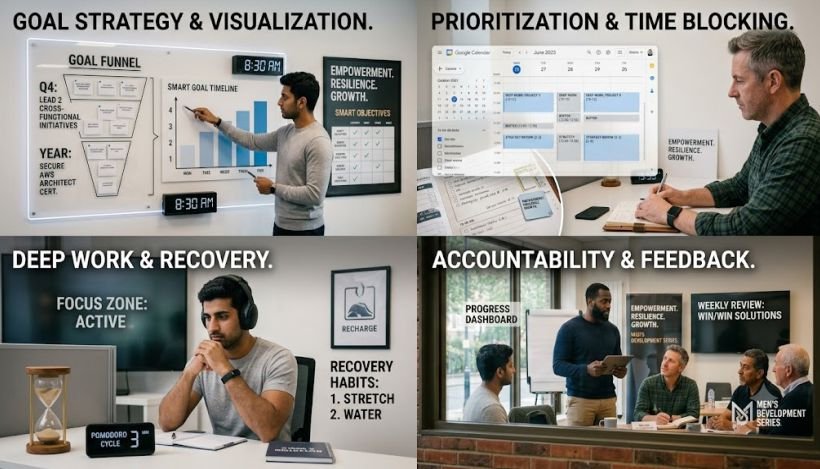
Researchers at University College London tracked 96 people building new daily habits. They found it took an average of 66 days for a habit to become automatic, with a range from 18 to 254 days.
Just as important, missing a single day did not ruin the process. Consistency across weeks mattered far more than keeping a perfect daily streak.
- Expect two to three months before a new habit feels natural.
- Start smaller than feels necessary, such as one push-up or one page.
- Attach the new habit to an existing one, like reading after morning coffee.
- Treat a missed day as noise, not failure, and simply start again tomorrow.
My switch from engineering to design followed exactly the same pattern, slow and uneven. I practiced design for an hour every evening for months before it felt like part of me.
Setting Goals That Stick
You may have heard about the famous Yale or Harvard study of written goals. Supposedly, the few graduates who wrote goals down earned more than all their classmates combined.
That study never happened, and nobody has ever found a record of it. Psychologist Gail Matthews of Dominican University searched for it, found nothing, and then ran her own goals experiment with 267 recruited participants.

People who wrote their goals, committed to actions, and sent weekly progress reports to a friend achieved far more. Their average score was 7.6, against 4.28 for people who only thought about their goals.
The lesson is clear and simple enough for any man to apply this week. Write the goal down, name the first specific action, and report your progress to someone you respect every week.
Confidence and Self-Esteem
Confidence grows from evidence, meaning small promises kept to yourself and challenges faced rather than avoided. It cannot be faked for long, but any man can build it with steady practice.
Low self-esteem tends to hide behind anger, people-pleasing, or constant joking at your own expense. Recognizing those patterns honestly is the first step toward changing them for good.
- Steps toward lasting self-confidence that does not depend on approval.
- Warning signs of low self-esteem and how to respond to them.
- Self-improvement for quiet men who recharge alone.
- Making first impressions count in work and social life.
- Confident eye contact without staring.
- Walking with presence and poise, shoulders back and head up.
Emotional Intelligence and Feelings
Many men were raised to hide difficult emotions, and that habit carries a cost. Emotions ignored for years tend to leak out as stress, irritability, or distance from loved ones.
Emotional intelligence means noticing your feelings, naming them, and choosing how to respond. It also means reading other people well, which helps in marriage, friendship, and work.
- Emotional intelligence for men, and why it signals strength.
- What bottled-up emotions cost men, and healthier ways to cope.
- Seven things to let go of for a happier life, from grudges to perfectionism.
Resilience and Setbacks
Every man faces setbacks, such as a lost job, a failed business, or a relationship that ends. Resilience is not avoiding those blows, but continuing to function and adapt through them.
Harrison Ford understood resilience long before he became a household name in Hollywood. He spent about fifteen years moving between carpentry and acting to support his family, before George Lucas cast him as Han Solo.
He did not sit and wait for the perfect role to arrive. He built cabinets, kept auditioning, and stayed ready, which is resilience in its plainest form.
Learn to separate the event itself from the story you tell yourself about it. Losing a job is a fact, while “I am a failure” is an interpretation, and usually a wrong one.
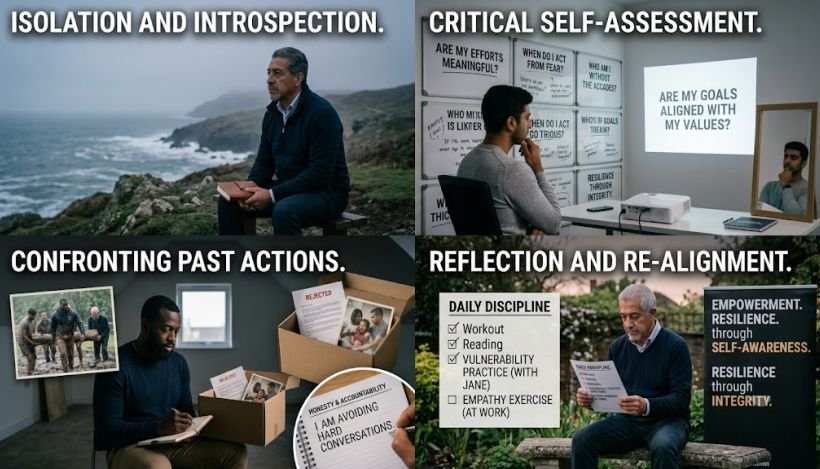
Talk to someone during hard seasons, such as a friend, a mentor, or a counselor. Carrying a setback alone makes it heavier, while sharing it makes it smaller. Strong relationships and how men show up in them matter most in hard seasons.
Self-Awareness and Journaling
Self-awareness means seeing your real strengths and weaknesses, not the flattering or harsh versions your ego prefers. It lets you spend your limited time and effort where they will actually help.
Journaling is one of the simplest and cheapest tools for building self-awareness. Cornell University’s Evidence-Based Living reviewed the research, including a meta-analysis of 13 studies on expressive writing, and found benefits for mood and stress.
Actor Matthew McConaughey offers a famous example of the habit in action. He wrote his memoir Greenlights during a desert retreat, drawing on 36 years of journals he had kept since his teens.
A simple practice works best for most men, especially at the start. Spend five minutes each evening writing what happened, how you responded, and what you would do differently tomorrow.
Stoic Philosophy for Everyday Life
Stoicism gets quoted constantly in men’s self-improvement circles, usually reduced to “never show emotion.” That shallow reading misses the point of the philosophy entirely.
The Stoics taught men to separate what they control from what they cannot, then put their energy into the first. Your actions, words, and attitudes belong to you, while other people’s opinions do not.
Marcus Aurelius, a Roman emperor, kept a private journal of these reminders, later published as Meditations. Nearly two thousand years later, men still read it for steadiness and perspective.
Try a short evening review, asking what went well, what went badly, and what was truly in your control. It costs nothing and takes less time than a few minutes of scrolling.
Spirituality and Meaning
Spirituality does not require a particular religion, though for many men it includes one. At its heart, it means connecting to something larger than your immediate wants.
For some men that is faith and prayer, while for others it is meditation, time in nature, or quiet reflection. Each builds the same skill, noticing a reaction before acting on it.
Men who dismiss this area as soft tend to gain the most from it. A few quiet minutes each day bring calm that no productivity app can deliver.
Career Growth and Purpose at Work
Career growth responds to the same habits covered above, applied steadily rather than in bursts before a review. Skills, reputation, and relationships build slowly at first, then pay off quickly later.

Purpose matters here more than most men expect, as the Gallup figures above show. Work that serves others well tends to feel meaningful, whatever the job title.
- Well-paid careers worth considering, with pay and growth data.
- Building a professional network without feeling fake.
- Business manners that earn respect from colleagues and clients.
Learning New Skills
Learning keeps the mind flexible and opens doors that a fixed skill set keeps shut. Pick skills that serve your goals, such as public speaking, writing, cooking, or a new language.

Money skills deserve a place on that list, because so many adults lack them. FINRA’s 2024 survey found that only 27 percent of US adults answered at least five of seven basic financial questions correctly. For decisions about your own finances, always speak with a licensed financial adviser.
Hobbies count as learning as well, especially ones that build skill and friendship together. You can browse hobbies that build skill and friendship for fresh ideas.

Masculinity and Character
Good character sits at the center of every other topic on this page, including everyday manners for gentlemen. Habits, goals, and confidence mean little if a man treats people badly along the way.
Gentsways favors a healthy view of masculinity, where strength protects rather than dominates. The posts below look at the debate honestly from several different angles.
- Defining masculinity today, beyond slogans.
- Healthy, positive masculinity built on strength used well.
- The problem with toxic masculinity and how to avoid it.
- Fragile masculinity and its signs, from defensiveness to insecurity.
- What it means to be a real man in daily life.
- The high-value man debate and what holds up.
- Becoming a gentleman in daily life, one habit at a time.
- The finest qualities of a gentleman and how to build them.
What Holds Men Back
Some of the most harmful things to a man’s potential are habits he barely notices. Spotting them early can save a man years of frustration and regret.
- Waiting for motivation. Action usually comes first, and motivation follows once you see progress.
- Isolation. Men without close friends lose perspective, support, and honest feedback.
- Endless scrolling. Hours of passive screen time crowd out reading, skills, and rest.
- Pride. Refusing help or advice keeps a man stuck far longer than necessary.
- Comparison. Measuring your life against highlight reels breeds envy rather than growth.
- Fear of starting late. Many men never try because they think the window has closed.
Morgan Freeman offers the best possible answer to that last and most common fear. He worked for decades in theater and television before his film breakthrough came at age 50 with an Oscar-nominated role in Street Smart.
Personal Development by Life Stage
The principles stay the same at every age, but the priorities shift with each decade.
In your twenties. Build foundations, such as habits, skills, friendships, and a clear sense of your values. Read a life plan for young men and relationship lessons worth learning early.
In your forties. Many men pause to reassess work, marriage, health, and purpose. See milestones to aim for by 40 and what turning 40 brings.
In your fifties and beyond. Growth continues through mentoring, new interests, and deeper relationships. The section on personal growth after fifty covers this stage in full.
How to Start
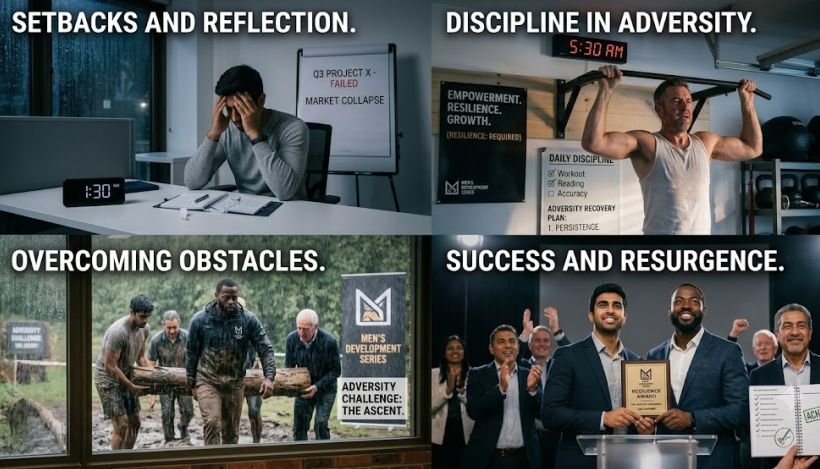
Pick one area from this page to work on, not five at once. Trying to fix everything at once is the fastest way to fix nothing at all.
- Choose one area, such as habits, confidence, or journaling.
- Write one specific goal with a clear deadline.
- Name the first small action you will take tomorrow.
- Tell one person you respect, and report your progress every week.
- Track it daily for at least 66 days before judging the results.
For further reading, Stephen Covey’s The 7 Habits of Highly Effective People and Daniel Goleman’s Emotional Intelligence both hold up well. Marcus Aurelius’s Meditations also rewards slow, careful reading across many quiet evenings.
Final Words from Gentsways
Leaving engineering for design taught me that the hardest change is giving yourself permission to change.
My father, quietly reading every evening, showed me that growth never has to stop, as I described in the lessons my father left me.
Personal development for men works the same way, slowly and steadily, one habit at a time.
Pick one area from this page today and write down one goal. Then tell a friend about it this week, and check in with them every Sunday for the next ten weeks.
Frequently Asked Questions
What is personal development for men?
It is the steady work of improving a man’s habits, goals, emotions, character, skills, and sense of purpose. It continues through every stage of adult life, from youth to retirement.
How long does it take to build a new habit?
University College London researchers found an average of 66 days for a habit to become automatic. The range ran from 18 to 254 days, depending on the habit.
Does writing down goals really help?
Yes, especially once you add a trusted friend to hold you accountable. In Gail Matthews’ study, people who wrote goals and sent weekly updates achieved far more.
Where should a man start with self-improvement?
Start with one area, one written goal, and one person to report to each week. Track your progress daily for about two months before you judge the results.
Disclaimer. This article is for informational purposes only and does not constitute medical, psychological, or financial advice. The author is not a therapist, doctor, or financial adviser. Where content is based on personal experience or observation, this is stated clearly in the article. Please seek a qualified professional if you are struggling with your mental health.